I do not put ads on my blog but do have a counter that shows me how many visits the pages get. (The stats. count is just there so I can see if I am 'talking' to myself, luckily so far this has not happened.) By continuing your visit here you are consenting to the stats. counter tracking cookies. Cookies, that sounds like something nice to eat but not that exciting.

Growing Your Own Fruit and Vegetables

We grow our own fruit and vegetables for our meals for as much of the year as we can. Without a greenhouse we have to buy shop food in the winter months but in the spring, summer and autumn we often have enough to share with family and friends.

Read about growing your fruit and vegetables here on my growing your own food pages.
Showing posts with label alltoment. Show all posts

Monday, 28 November 2011

Make Compost Faster - five things that turn waste into compost quicker

Making Compost, Ways to Speed up the Process of Compost Making.
To turn the items that you can put on the compost heap into compost faster there are certain things you can do.

Here are five composting tips to turn your heap into compost faster -
  1. Heat speeds up the process so keeping the heap warm will aid the breaking down process. 
  2. Turn the pile of composting materials over, as turning the heap incorporates air and that too speeds up the composting process.
  3. Add plants to the heap such as the leaves of the comfrey plant as it is said to accelerate the making of compost. 
  4. Putting horse muck on the heap speeds up the compost making.
  5. Layering the things that you add to the heap - so that you add alternate layers of 'greens' and 'browns' that is not the necessarily the  colours of the things you are adding to the heap but their categories. 
A quick short list of the categories for greens and browns when making compost....
  • When composting browns are things like cardboard, paper and fallen leaves.
  • When composting greens are things like vegetable peelings, bedding plants that are finished with in the garden, rhubarb leaves.
More on greens and browns in my next post here.
Thursday, 24 November 2011

Cutting Down on What we Waste is one of the Lessons learned from Growing our own Fruit and Vegetables

Since Growing our Own Fruit and Vegetables we waste less, and compost more.  


  • We now have a  rubbish bin and a recycling bin that is not full.
  • We Compost as much kitchen waste as we can.


  • We use the food we buy and grow and try not to throw any away.
  • We are aware of food miles and check were any bought vegetables and fruit are from.

Growing my own fruit and vegetables has brought home to me, that it really is wrong to throw good food in the bin if you can prevent it.  I never was one to discard good food but the skills of soup making from the vegetables that I grow and cooking up the fruits into something tasty have improved my coking skills

Wednesday, 23 November 2011

Some things that you must not compost

There are some things that you should not put on a compost heap, mainly for health reasons or because they will cause problems - 


Here is a list of a few things that should not go into compost


  • Pet waste such as cat or dog waste, 
but guinea pig and rabbit bedding is OK as it is good for composting.


  • Meat, cheese and general kitchen waste cooked food
this is because it encourages rats and mice. 


  • Perennial weeds, (and weeds with seeds if the heap is not heating up enough to kill the weed seeds).

Grass cutting are OK in the compost but not a huge heap of cuttings thrown into the bin or on the heap in one go. 


Planting Garlic Now - well as soon as possible

Garlic needs to be planted and in the ground when the temperature drops. The reason is that it needs the spell of cold weather to encourage the individual cloves that you plant to split into cloves before they grow and plump up later on in the growing season.

Sunday, 20 November 2011

Ten Things You Can Compost, everyday things that can be composted easily.

Here is a list of 10 things you can put onto the compost heap or into the compost bin...

  1. Banana skins.
  2. Vegetable peelings.
  3. Brown cardboard boxes.
  4. Bedding from the rabbit hutch or guinea pig hutch, this will be mainly straw or hay with a bit of rabbit or guinea pig poop included. 
  5. Grass cuttings (but do not throw on too many at once. Do not use grass cuttings for compost heaps and bins if you have used chemicals such as weeding or feeding mixes.)
  6. Tea bags (so long as yours do not have 'plastic liner').
  7. Coffee grounds.
  8. Egg shells (you might want to crush them first as they compost down quicker if you do.)
  9. Kitchen towel that has not been near meat or cleaning chemicals.
  10. Anything old that is made of 100% cotton like t-shirts; but they do take a long time to compost down. 

Monday, 18 January 2010

Rhubarb, a word about rhubarb...

If you have recently taken over an allotment look out for signs of rhubarb emerging soon.
The first year I had my plot I was thrilled to discover it coming through in an area that I had thought was just grass and weeds. I left mine where it was the first year and had a generous supply of rhubarb sticks that year. We had rhubarb and custard and rhubarb crumble on the menu quite a lot that year.

Last year because I dug some up and split and replanted most of the plants
I was unable to harvest from them so my crop was reduced. This year I am hoping for a good harvest as the replanted ones were treated to being planted in an area that had been enriched with well rotted horse manure.

If you wish to force rhubarb in your vegetable patch or on your allotment start to look for a suitable plant/plants and also something to cover it with.

To Force Rhubarb:

  • Clear away any debris such as old leaves from around the plant crown.
  • Place a few handfuls of dry straw over the plant.
  • Cover it up with a large upturned bucket or dustbin. Or if you wish to make an attractive feature of it in your vegetable garden and money is no object buy a terracotta rhubarb forcer. (I would not risk this on an allotment).
The forced rhubarb should be ready in about eight weeks they will be tender young stems and the colour of them is wonderful.

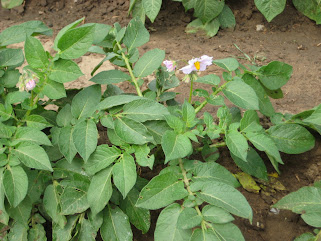
a healthy potato plant in flower

a healthy potato plant in flower
photo of potatoes in flower

home grown carrots.. grown from seed

home grown carrots.. grown from seed
photo of my first bunch of carrots 2009

Even a small batch of mixed fruit can be useful

Even a small batch of mixed fruit can be useful
Home Grown Fruit can be made into delicious compote